Saturday, March 29, 2014

M&M World is Now Open in Topeka for Two Weeks

Today my wife and made our way downtown and visited the temporary (pop-up) M&M World Store. 
Large lines of M&M fans
wait to enter the
M&M pop up store in downtown Topeka.
Photo by Kevin Surbaugh
All kinds of M&M merchandise
on display in the M&M World
Store in downtown Topeka.
Photo by Kevin Surbaugh

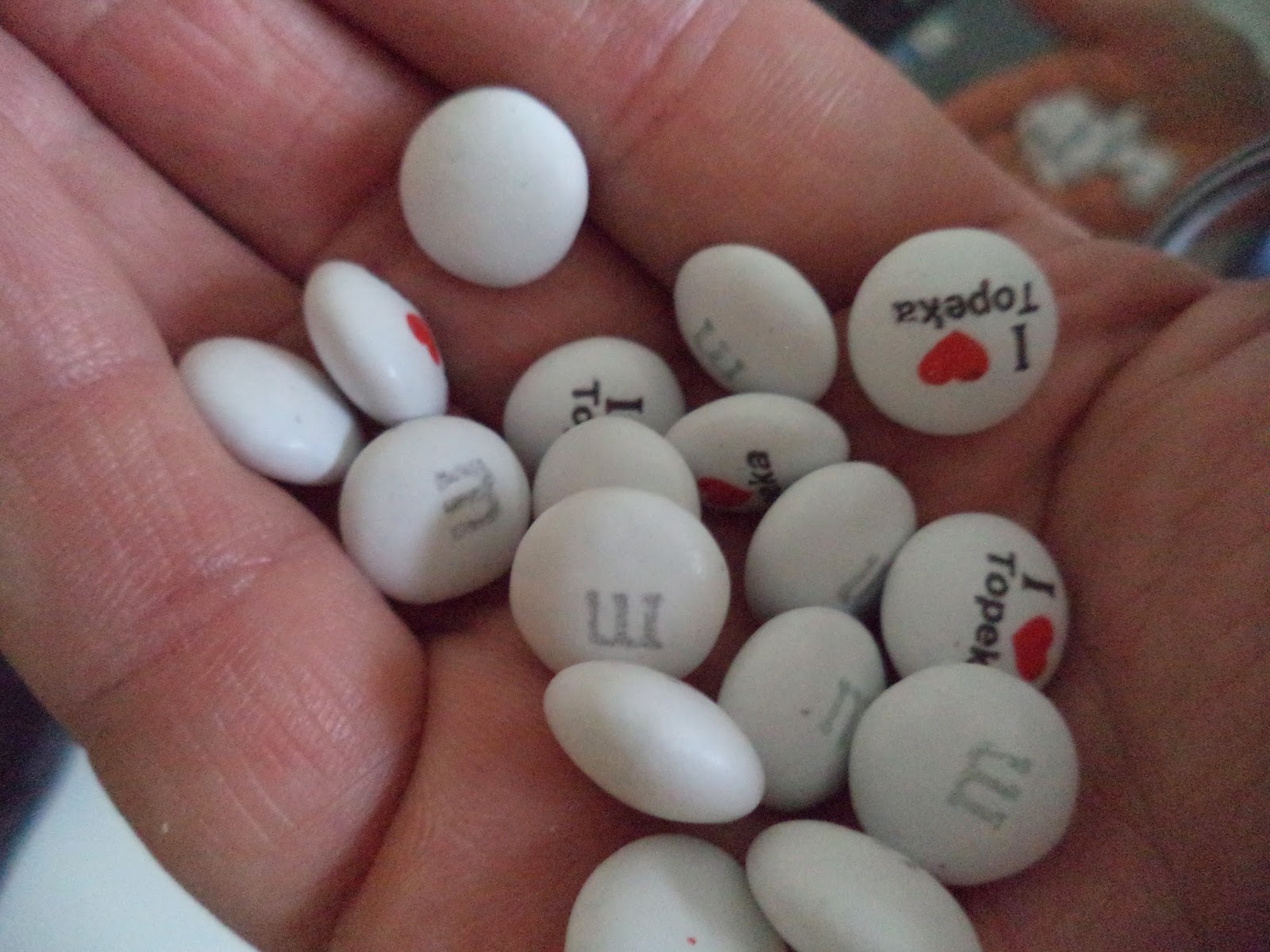
We had to wait for more then an hour before being able enter the store.  Though they had some custom made M & M's that said I Love Topeka, those were almost sold out. My wife and I were able to purchase 1/4 LB of these at $12.99/LB, as you can see in the bottom right picture.  I just wish that the store was going to be around more then a couple of weeks.  Of course downtown, especially that side of the street is not the most handicapped friendly. In fact there is no ADA parking on that side of the street. Still though  it was worth making the trek down there.  Hopefully the powers that be, will change their mind and establish the store full time. Then the only question that I will have is, does the new plant offer tours?

Pat posing with the large M&M
on the sidewalk outside the pop up store.
Photo by Kevin Surbaugh

Some of the I Love Topeka
M&M's that was for sale
in the M & M pop up store.
Photo by Kevin Surbaugh

Friday, March 28, 2014

State Capitol Building

photo by Kevin Surbaugh

photo by Kevin Surbaugh
There is so much to see in the Kansas Capitol, we were eager to see what the Capitol looked like after the 13 year and the $325 million renovation. We called (785-296-3966) ahead and were told the particulars of visiting on Saturday's. Only self guided tours, only between 8 am and 1 pm and plenty of handicapped parking in the underground garage, where parking is free. Unfortunately, when arrived on the Saturday morning we went, we found the parking garage closed. On closer examination of the sign that was posted near the entrance, we found that hours posted did not jive with what the visitors center had told us a couple days previously. The capitol police seemingly don't understand ADA issues and how difficult dropping off and leaving a handicapped individual (whether they be child or adult) and leaving them unattended for five minutes while you go park the car across the street.

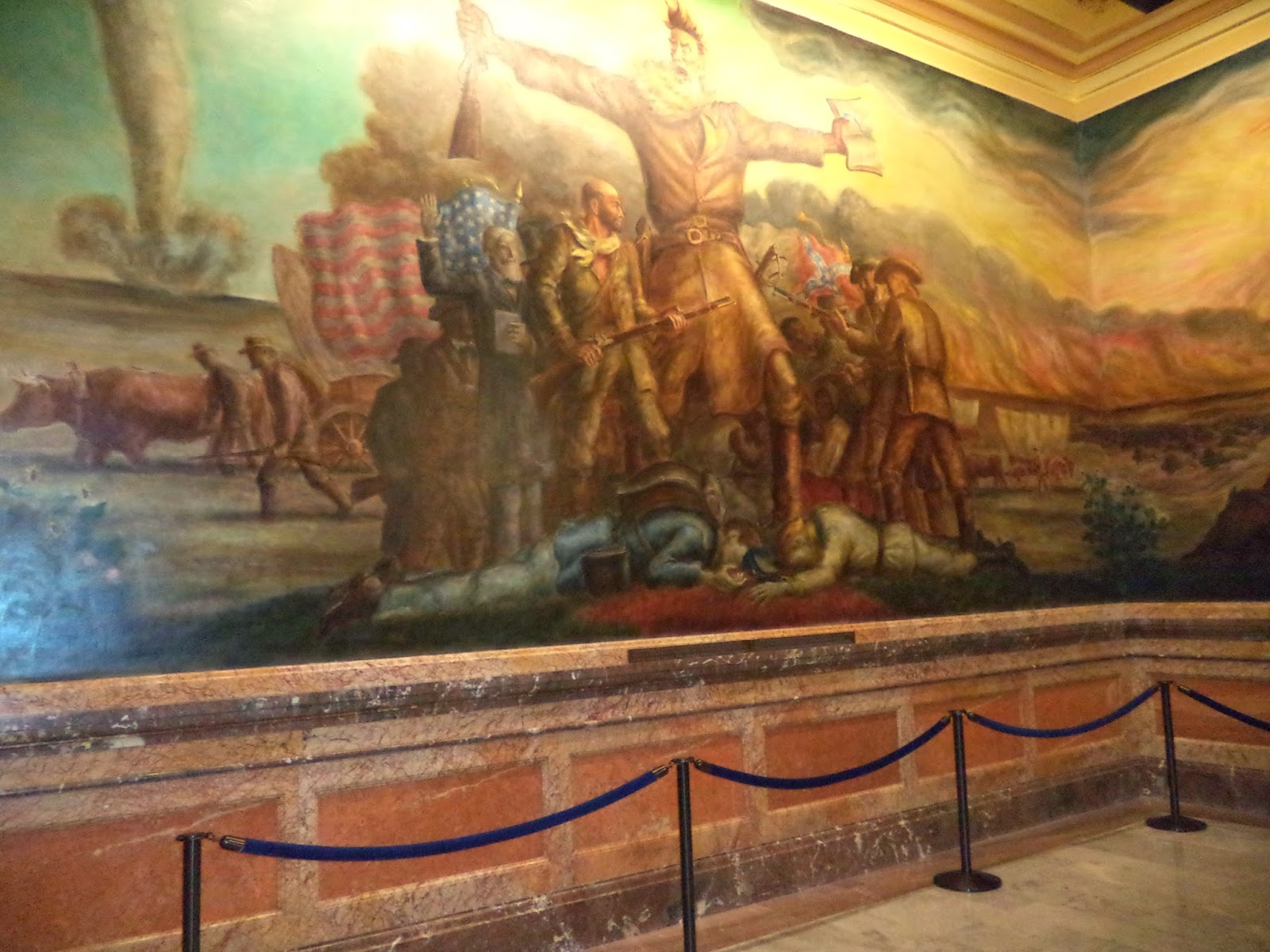
John Brown Mural
painted by John Curry.
Photo by Kevin Surbaugh
Still the best free attraction in Topeka, is the Kansas State Capital building. Despite the lack of foresight towards those with disabilities we enjoyed our visit to the peoples house.

A must see of any visit to the State Capitol is the murals by John Stuart Curry on the second floor. Curry's most famous works were these murals. In June 1937, newspaper editors in Kansas sought donations and raised the money to commission Curry (who was the most famous artist in Kansas at the time) to paint several murals in the statehouse. Curry's design was divided into three themes: first the Settlement of Kansas, which depicted the Conquistadors and the Plainsmen; second the Life of a Homesteader, which would depict John Brown (the most famous and depicted here); and third, Pastoral Prosperity which would include scenes of modern Kansas. Curry wanted to be free to express his own ideas regarding the murals: "I have my own ideas about telling the story of pioneers coming into Kansas. I want to paint this war with nature and I want to paint the things I feel as a native Kansan." Political controversy stalled the completion of the murals, which weren't finished until 1942. The murals however were left unsigned at his death in 1946. Also near these murals on this floor is the Governors office, which is part of the executive branch of the state government.
photo by Kevin Surbaugh


Photos by Kevin Surbaugh
Visitor Hours:
8 a.m. to 5 p.m. Monday – Friday
8 a.m. – 1 p.m. Saturday
Closed Sunday and state holidays
Historic and dome tours
are offered Monday through Friday.
Visit kansascapitol.org for tour times.
Parking Garage is closed to
visitors on weekends
and after 5:30 M-F
On the third floor is the legislative and the judicial branch. Well sort of. The Judicial branch was moved out to another building across tenth street in 1978. You can see the "Old Supreme Court Room," in the picture to the left. The justices met in this chamber in North wing until 1978 when the new Kansas Judicial Center was completed. Today the room is mainly used for committee meetings. Also on the third floor is the two houses of the state legislature. The House of Representatives (or lower house) meets in the west wing of the capitol. Work on the west wing, which is wider and longer than the east wing, began in 1879 and enclosed by 1880. Limestone from Cottonwood Falls was used for the west wing. The wing was still under construction when the Kansas House of Representatives convened in 1881. The House Chamber (as pictured above right) was restored during the summer of 1998 when the murals on the ceiling and the names on the wall were found and restored. The ceiling lights in this chamber were installed for the 2008 session and are replicas of the original gas lights. They are lowered on chains from the attic to change bulbs. The eternal lights on the Speaker's podium are kept burning at all times. The Kansas House consists of 125 Representatives, the members of which are elected every two years. 
In the east wing is the State Senate Chambers (or Upper House). During the recent renovations in the Senate Chamber (picture above left), the historic cast-iron columns and pilasters were restored by developing something called "in situ electroplating technique" to clean the copper and silver plating, then lacquered and hand polished to their original brilliant sheen. At the base of the podiums are the original coal burning stoves used to heat the chamber in the early days of the capitol.The Senate is made up of 40 Senators elected every four years. Between these podiums and the marble throughout the chamber, this is the most beautiful of the two houses (in my humble opinion).
The fourth floor is mostly committee rooms and the observation balconies which is where the wife and I were when we took these pictures of both chambers. From every floor you can see the inner view of the dome, although the most dramatic views, like this one is from the first
Inner View of the Dome
photo by Kevin Surbaugh
three floors which actually have a rotunda. It is especially beautiful with the newly polished copper. Which incidentally the copper that makes up the inner and outer dome would make 2,350,746 pennies.
Another gem and great site to see in the Capitol is the State Library which even has a glass floor on the upper walkway. However it is among the areas closed to the public on Saturday/s, so we were unable to visit or photograph it on this visit. However, I expect that we visit this building again some time in the future. 
Of course who can pass up mentioning the beautiful architecture. Especially that makes up the beautiful molding on the fifth floor.

molding on 5th floor
photo by Kevin Surbaugh
Also any visit, one must look around the expansive visitors center and see all that is on display there.  That is one thing that both my wife and I wish we would of had more time to explore.  Diffidently our next visit will include more time for this, the newest area of the People's House.


A piece of the original dome on display
in the visitors center.
Photo by Kevin Surbaugh


Wednesday, March 26, 2014

Fire Hydrant Garden

photo by Kevin Surbaugh


In a very modest neighborhood near the center of Topeka is what some would call a dog's paradise. This multicolored garden of fire hydrants, installed by the Claude Belshe over the years to keep his two dogs "busy and happy," includes hydrants from many eras, some undoubtedly valuable antiques, all of which have been brightly painted by the Belshe's stepson, Jeffery.
Apparently he started to collect and install old fire hydrants when the garden he and his wife planted was trampled by their dogs. The hydrants have become heaven for the dogs! Belshe plans for the garden to continue to grow (which now now numbers near 100) and is always on the lookout for more hydrants. The entire garden can be seen from the street as his dogs are very aggressive to protect their paradise! Belshe readily confesses, nobody is considered a serious collector until they have at least a hundred hydrants. Belshe, who is an encyclopedia of fire hydrant information and is a most gracious host, and is happy to show visitors around the yard.

photo by Kevin Surbaugh


Address:
720 S.W. 5th Street
Topeka, KS
on SW 5th St (a one way Street) between SW Taylor St. and SW Polk St.

photo by Kevin Surbaugh
Handicapped Accessibility:
It is a private yard and as such may not be the most accessible. Please be advised that entering the yard without permission is not advised.  All hydrants can be seen from the sidewalk and street which is pretty accessible.
photo by Kevin Surbaugh


Admission:
No Admission. Viewable from the public sidewalk

Sunday, March 16, 2014

Subway to Open New Cafe on South Topeka Boulevard

Today (Sunday March 16, 2014) I had a chance to attend a VIP preview of the new Subway Cafe in Topeka. So what is Subway Cafe? Subway Cafés leverage the chain's partnership with Seattle's Best (owned by Starbucks) to offer more of a coffeehouse ambiance. The set up is basically the same, as any other Subway, as customers can still come in and order their sandwich the way they always have. But Subway Cafés include some baked goods, dessert items and a full line of espresso-based creations. While any given Subway Café may include the $5 Footlong deal, premium beverages such as espressos, lattes, mochas, cappuccinos, teas, chai options, hot cocoa, and even a handful of frozen options are offered as part of Subway Café's menu. One thing to note here is that menu options may vary slightly from Cafe location to Cafe location.
photo by Kevin Surbaugh
Although this is a new concept in Topeka proper, it is not the first of this concept in the area. The Subway in the Pauline area of Topeka is also a Subway Cafe.
Over all there are 15 subways in the Topeka market, 13 of which are owned by the same franchisees. With this new location being among those 13. The address of the new location is 3217 sw Topeka Blvd and will open on St. Patrick's Day March 17, 2014 at 11 am. The hours of the new location will be 7 am - 10 pm and will include a drive-thru.
photo by Kevin Surbaugh

With so many people worried about Gluten Free diets, we wondered if they had any Gluten Free offerings. Subway is test marketing the idea in Dallas. The biggest concern is how to avoid cross contamination, which could be deadly for those with celiac disease. One possible salutation is a separate oven to bake the gluten free bread in. Then another issue on the same note is the prep area. All of these issues have to be addressed and figured out before Subway can roll out this option nationally. The Topeka owners are unsure when that might happen.
Subway Cafe employees Christopher Ortega,
Danielle Sparks and Jasmine Boyd
wait on customers with a smile.
photo by Kevin Surbaugh
During our time at the VIP preview, we sampled the Carrot Cake Muffin, which both of us thought was so good. With a carrot cake like taste and crumb top, it was melt in your mouth delicious, and the strawberry smoothie we sampled was superb also.
photo by Kevin Surbaugh
One other feature of this location is a meeting room that the restaurant plans to rent out free with $75 in purchases from the menu board (drinks, sandwiches or pastry items).  I certainly expect that my wife and I will be back to this location in the near future.
Photo by Kevin Surbaugh
The restaurant is handicapped accessible, however the ramp is on the Payless Shoe side. The owners told my wife and I that they do want to ask the landlord about placing another curb-cut on their end to help those with mobility issues.

Saturday, March 15, 2014

2014 Blarney Breakfast

The 20th annual Blarney Breakfast was a fantastic success was a great success this morning. Firefighters and police, including Chief (soon to be U.S. Marshall) Ron Miller served as wait staff. Below is a photo gallery of some of the  sights and sounds of this great event. After perusing the photos, don't forget to checkout the video as well.

The Bagpiper at the 2014
Blarney Breakfast in Topeka.
Photo by Kevin Surbaugh
Dagan in the
St. Patrick's Day Spirit.
Photo by Kevin Surbaugh
The food line is long,
the food is delicious
and even includes the great Irish cereal,
"Lucky Charms".
Photo by Kevin Surbaugh
photo by Kevin Surbaugh
Fruit Carvings  Photo by Kevin Surbaugh
photo by Kevin Surbaugh


Joe Frydryce and his wife
enjoy the great food and bagpipes.
Photo by Kevin Surbaugh


Thursday, March 13, 2014

Prize Package

We are on the search for the best burger in Topeka. Here is how we rate the burger joints that we will review. First we put heavy emphasis on where the joint is headquartered, Local (Topeka) will garner an automatic 10 bonus points. Kansas owned chains (headquartered in Lawrence, Wichita, etc) an automatic 5 bonus points and National chains (those headquartered outside the state) will garner an automatic 0 bonus points.  The ten categories that we will use in our search for the best burger in Topeka will be 1.Burger Patties Quality, 2. Bun Quality, 3. Customer Service, 4. Garnish Quality, 5. Fries Quality, 6. Atmosphere, 7. Order Accuracy, 8. Cleanliness (Restrooms, Dinning area, Entrance, etc), 9. Building Accessibility and 10. Price. All categories will earn a score between 1 and 10, with 10 being the highest and 1 being the poorest.
photo by Kevin Surbaugh
Prize Package is one of those unique gems every city should have. Nestled in a small unassuming building (that looks like it was a gas station in earlier days), this place is well respected for its burgers and chili dogs.
photo by Kevin Surbaugh
Bonus Points:
10 points
This is a Topeka only operation.

1.Burger Patties Quality

8 points
In my humble opinion the burger quality  was good, however it is a good thing I got a double. The burgers were thin, so the double made more meaty to truly enjoy the burger taste.

2. Bun Quality
6 points 
The bun was good, but I wouldn't call it anything special. It wasn't toasted or buttered.  It appears to have simply been taken out of the bag with the burger makings then simply placed on the bun. 


3. Customer Service
10 points
I truly enjoyed the great friendly customer service.


4. Garnish Quality
8 points
The garnish was fresh. The only downside was they were out of lettuce.  The issue with the lettuce was the only thing that brought down the rating.


5. Fries Quality
7 points
The fries were very, very tasty  until my very last bite. That bit included a small piece of onion ring which I didn't know about before I bit into it. Not a good thing for someone with an onion allergy.  I was prepared to give the fries a higher score before this bite, but the last bite ruined the great experience my wife and I had with the fries.


6. Atmosphere
9 points
The only thing I can really talk about as for atmosphere is the great oldies music that was playing in the background.  The place also is kind of like a mini convenience store as well. They also sell cigarettes, tobacco and lottery.


7. Order Accuracy
Fill


8. Cleanliness (Restrooms, Dinning area, Entrance, etc)
10 points
Entrance: Didn't see a speck of dirt or trash anywhere around or inside the entrance/lobby area.
Dinning Area: N/A (There is no seating area)
Restrooms N/A (There is no public restrooms)

9. Building Accessibility
9 points
   The building is pretty accessible for those with mobility issues. The only downside would be when a line develops inside, in the small area in front of the counter. The only downside is that there is no handicapped parking, in-fact there isn't much parking at all.
photo by Kevin Surbaugh


10. Price
9 points
The pricing of this burger joint is absolutely great at $2.05 for a double burger, $2.35 for the 1 large fry my wife and I shared and 95 cents per 12 oz can of soda pop. Really the only downside is that they only accept cash. Which is a plus (as to many use credit like it's going out of style), but often times I run my debit card as credit, because I don't have the cash on me. They did tell me that they were working on getting the capabilities of taking cards, but didn't know when that would happen.

Over all we really enjoyed this place.  The over all points for this review was 9.8 points

Address:
1420 SE 6th Ave
Topeka, KS 66607
Phone:
(785) 232-5764
Hours:
Mon-Fri 10am-7pm

Monday, March 10, 2014

M&Ms World Coming to Topeka Briefly

Recently Downtown Topeka, Inc announced on their Facebook page that a temporary (pop-up) M & M's World store will be opening in downtown Topeka (March 28-April 13, 2014).  The store which will be open 11 am-6 pm (Mon-Fri) and 12 pm-5 pm (Sun), will feature some items that have a special "Made in Topeka" logo to celebrate the opening of the new Mars Chocolate plant this spring. According to a report in the Topeka Capital Journal,
Some of the proceeds from a “pop-up” store opened by Mars Inc. will benefit downtown revitalization, according to Topeka boosters.
- Topeka Capital Journal
To me it sounds like a great place to stock up on some great chocolate candy.

St. Patricks Day Parade

It is time once again for the 35th annual St. Patrick's Day Parade. This years parade will be Saturday March 15, 2014 with the parade commencing at 12 noon. Those who are in the parade will start gathering at 10.  Besides the parade food will be available, starting at 11:30 am in an outdoor Beer Garden.
The Irish Fest will be open until 6pm. Sounds like a great Topeka St. Patrick's Day "crawl" between the Irish Fest, the Celtic Street Fair, (1-4pm) at Sixth Avenue Ballroom, and the Celtic Fox.
In addition, there is also the 6th annual Great Topeka Bed Race at 6th and Jackson with check-in and inspection at 8am with the Race beginning at 10:00am certainly a fun time for all.

Tuesday, March 4, 2014

20th Annual Blarney Breakfast

One of our favorite things to do around St. Patrick's Day each year is the annual Blarney Breakfast. What
a better way to spend breakfast on the Saturday closest to Saint Patty's day. A buffet breakfast supporting the Capper Foundation, which helps people with disabilities. The 20th annual Blarney Breakfast will be at the Texas Roadhouse, located at 5901 SW Huntoon, on Saturday, March 15th from 6-10 a.m. All the food is provided by Texas Roadhouse. While you are enjoying the great food, you can also enjoy bagpipers, balloon artist and face painting for all the wee lads and lasses.
Tickets for adults are $10 each and children are two for one at $5 each.


"May the sound of happy music...And the lilt of Irish laughter... Fill your heart with gladness...That stays forever after."
--Irish Proverb

Thursday, February 27, 2014

Matrot Castle

photo by Kevin Surbaugh
History of Matrot Castle
The information below came from the website of the current owner: Matrot Castle)
According to local history or perhaps legend, Seraphin Matrot, was a nineteenth century French immigrant known to his new neighbors as the eccentric "old gentleman," who relocated his family 7,500 miles from Paris to the seclusion of rural Topeka, Kansas. He had been a wine merchant, a contractor, and a political refugee, who sought asylum in the beautifully crafted Normandy-style castle that he built from ground up. He chose for his homestead one of the most remote but accessible locations in the West. According to oral tradition has it that he had narrowly escaped the guillotine before fleeing his homeland with his wife and three children.

Documents do verify a long-held local tradition that Mr. (or Monsieur in French) Matrot was sought by French authorities due to his political affiliations in Paris during the mid to late 1800s. Having escaped to the Topeka Township sometime around 1873, it is a fair assumption that the political persecution he feared was related to experiences before, during, or after the notoriously brutal insurrection of 1870-71, a massacre known as the "Semaine Sanglanta" (trans. "The Bloody Winter").
During the period following the surrender of Paris to Germany at the end of the Franco-Prussian War, thousands of working class Parisians were summarily tortured and executed for their association with the Council of Paris (a.k.a. the Commune of Paris). The Commune, a populist political faction with roots in the French Revolution, consisted of well over 100 thousand Parisians who called for economic and political freedom from the monarchy, and from other perceived threats to social liberty for the common man. The origins of this political party are dramatically portrayed in the classic novel and stage play entitled "Les Miserables," by Victor Hugo. Consistent with the party's socialist if not purely democratic ideals, the Commune rebelled against their governments' surrender of Paris to Germany in 1870.

From what we've learned of M. Matrot's background as a Paris wine merchant, and a member of the Paris Police Force (which the Franco-Germans disbanded for its alleged treason during the insurrection), it is likely that M. Matrot came to Topeka with a fear for his life that was less than unreasonably paranoid. Oral family tradition relates an occasion in which Ms. Matrot had fought in a street battle alongside her husband, coming to his assistance to remove a black powder stain from his hand. Most of M. Matrot's comrades suffered much more in one of the shortest but bloodiest civil wars in modern history.

Contemporary observers estimated that 30,000 Parisians, most of them middle class men, women, and children, were tortured and killed. Thirty eight thousand were arrested and held in concentration camps, and over 7,000 were banished to deserted French islands. One such account describes the plight of Parisians who faced the same genocide that M. Matrot successfully avoided:

…Prisoners were formed into long chains… so as to form one body [in convoys from Paris to the camps]. … It looked like the population of a city dragged away by fierce hordes …Panting, covered with filth, idiotic with fatigue, hunger, and thirst, burnt by the sun, the convoys dragged themselves along for hours …harassed by the cries, the blows from the mounted chasseurs … The captives who fell were sometimes shot, [or] thrown into the carts that followed … There were no doctors, gangrene attacked the wounded; opthalmia broke out; deliriousness became chronic. In the night were heard the shrieks of the feverstricken and the mad. Opposite, the gendarmes remained impassive, their guns loaded. … Hunts were organized in the forests near Paris. Police watched all the stations, all the ports of France. Passports had to be renewed and checked at Versailles. The masters of boats were under supervision …

Some historians even trace the origins of the first World War to the Council's martyrdom. Many future revolutionaries and democratically-minded citizens looked back for inspiration at the legion of struggling merchants like Seraphin, who aligned themselves at their own peril with the cause of personal freedom and social security. Vladimir Lennon, the founder of modern socialism, requested that his body be draped and entombed with the Commune's red flag. It was from this chilling history that Seraphin Matrot brought his young family to build a fortress, a replica of the castle from which he was evicted in France, to the western Topeka, Kansas.

M. Matrot's new homestead was in no city on a hill. To shelter his family with obscurity, he picked for a homestead a valley far from what little civilization existed in Shawnee County at the time. Although the castle is said to be identical to the home he left in France, as a gesture to his uprooted wife, the most remarkable aspects of the structure's architecture indicate that it was built, as the castles of the medieval period, for the protection of its inhabitants.

The windows in the three story turrets faced in three directions, and contained holes through which to fit the barrels of firearms. The walls of the castle were a full foot thick, sufficient to repel a small army, and well beyond what was needed to protect his family from a Kansas tornado. The most impressive feature of M. Matrot's security system was a secret tunnel that extended from the wine cellar, beneath the grape crops, to a ravine 500 yards northwest of the property. The wine cellar itself, with it's high arched brick ceiling, was built 26 feet long and 13 feet wide – small for a wine cellar, and adequate to hide a family of five in the event of an attack on the fortress from without.

The principal purpose of the wine cellar was to provide an optimum environment for the fermentation of grape juice into wine. The turrets were originally open from the cellar to the top of the three story spires to allow maximum ventilation for the casks stored below. Also, diagonal shafts forced low cool air into the cellar from the castle's east exposure, providing an optimum climate of air and light. Not only did the construction project demand painstaking hours of design work and labor, the grape vines that were planted needed to be carefully tended for several years before a harvest of grapes could be had. One can imagine the apprehension Mssr. Matrot must have suffered as his dream of recreating his life drug on slowly, year after year. As his fear of the French bounty hunters subsided, the forces of history were once again raising its misery to Matrot again.

Prohibition came to Kansas in 1881. Kansas was the first state to constitutionalize the prohibition of intoxicating beverages, and one of the last states to repeal it. Presumably unknown to the French king of Matrot Castle, his was now the home state of Carrie Nation, and becoming the Kansas law, which took effect in 1871, strictly enforced the prohibition. During this time, M. Matro was building his wine cellar, and nurturing his grape vines to maturity. Enforcement, particularly in the capitol city, was lax.

Many wineries and breweries skirted the prohibitory law by taking advantage of the exception it created for intoxicants prescribed by physicians. This prevelantly channeled loophole garnished national attention; the Boston Transcript noted in 1882 that "Kansas physicians help the droughty ones to get around the prohibitory law by prescribing liquor for [every] ill. For a boil on the arm, one patient was ordered to take, in eleven days, ten pints of "spiritus fermenti" [i.e. wine] and thirty bottles of beer … boils are very fashionable in Kansas."

But by 1885, at about the time M. Matrot's cellar and vines should have been ready to re-establish him in his new neighborhood as a wine merchant, the Kansas Legislature tightened its restrictions. In short order, all of Topeka's established local breweries, wineries, and distilleries were out of business or converted to other commercial purposes. No reference has been found to document that M. Matrot ever sold a bottle of wine. If he did, it was likely to organized bootlegging operations, which generally specialized in liquors rather than wine or beer, because the "hard stuff" could be transported more compactly, with more punch, and pennies, for ounces sold.

The Matrots may have harvested grapes for juice, and a very limited amount of wine for medicinal purposes, but the latter practice was also greatly curtailed state-wide by the 1885 legislation.

Even if no one else benefited from the Matrot Winery and Vineyards, Seraphin himself apparently did. Family tradition holds that the "old gentleman" even had a dumbwaiter mechanism to draw wine, a bottle or glass at a time, from the cellar through the turret floor to his first story living quarters so that he didn't have to navigate the castle's brutal spiral steps for refills.

History leaves to curious speculation the question of Madam Antoinette's misery during her years at Matrot Castle. One can only wonder about her attitude toward the drinking habits of her husband, and about the way she felt about the scores of Shawnee Indians that he retained, paid with wine on site, to literally build the castle up around her family. Some have suggested that it may well have been Antoinette's outrage over Seraphin's drinking, not to mention his notoriously miserable luck, that accounted for his decision to build the cellar hide-out and secret escape hatch to begin with. Perhaps the hidden tunnel was built with escape from his wife in mind!

Altogether, it would seem that the M. Matrots' long and hard labor was virtually in vain. "The old gentleman," as some of his contemporaries remembered him, was seemingly oppressed again by political realities over which he was repeatedly rendered powerless. He passed away on the second story of his home, in May 1898. According to his neighbors, Seraphin was a man with no religious beliefs. Newspapers report that his coffin could not be navigated up or down the narrow spiral staircase, so a second story window had to be removed in order to hoist the coffin up and down. This suggests that by the time his body was found and tended, rigor mortis prevented the transport of his body down the staircase as well.

Antoinette is said to have fled back home to France only to be stoned to death in 1914, presumably for her and her husband's involvement in the Paris underground. Census records support that in 1910 she was still living in the castle, with her son-in-law, Eugene (by marriage to her late daughter, Blanch), and Eugene's six children. No record of her is known thereafter.

Prior to Antoinette's departure from the castle, Eugene's family lived there for several years. Subsequent owners made various efforts to renovate and restore the property. These include E.E. Moore to 1933; Elroy Vitt, from 1933-1946; George Burns and Earl Green, Jr (cousins returning from World War II) from 1946-1947; Julius Perkuhn, who added the west addition around 1947; S.K. Vincent until the early 1970s; Paul Clark, who restored the original mortar work and undertook several modernization projects through the mid 1970s; Brad Miller for a couple years thereafter; Mark Stillings through 1978; Caroline Kirk from 1992-2004; and Jerry Wittmer from 2004 to the present.

Previous owners have been spooked by strange phenomena that some believe is caused by the unsettled spirit of M. Matrot himself. One of Paul Clark's sons recalls: "We have many stories of furniture moving, doors opening and closing, pounding noises coming from the living room floor, the sound of phantom footsteps when no one else was present, and other poltergeist-type events…[and other experiences] which were very frightening… "

In addition, other owners, including its current inhabitants, have noted interior lights igniting when no switch was turned, and noises from various vacant locations within the castle. Sadly, at least one former resident of the Matrot castle ended her own life on the premises.


Location:
6424 SW Huntoon Road
Topeka, KS 66615

photo by Kevin Surbaugh

Handicapped Accessible:
A individual can maneuver on the paved parking lot/driveway pretty easy.  However, entrance to the winery, which is in the castles basement appears  to be a no go for those of us with limited mobility.
When I spoke with the owner, he said that when the weather is nice, he would be more then happy to bring up samples for those with mobility issues, as they sit outside at the picnic table, during winery hours.  As far as the tours, because of the historic nature of the house, he is unable to add an elevator or other wise alter the house to make it accessible.


photo by Kevin Surbaugh
Hours:
Winery Hours
Open 11 a.m to 7 p.m. Saturdays

Tours by Appointment, contact (785) 215-3425 or click here for more information.

photo by Kevin Surbaugh


Tour Admission: